

Why Choosing the Right Tire Type Matters in Canada
When you live in a country with unpredictable weather like Canada, choosing between all season tires, all weather tires and winter tires can be confusing. Each tire type performs differently depending on temperature, road conditions and your driving habits.
Whether you’re preparing for winter in Quebec, driving through rainy British Columbia, or cruising the dry roads of Alberta, understanding the differences between these tires can help you save money, stay safe and drive with confidence.
When comparing all season or winter tires, it’s important to think about your local climate, driving habits and how often you face snow or freezing temperatures.
Understanding Tire Types Before You Buy
Choosing the right tires for your vehicle is more than just a seasonal decision, it’s a safety investment. Whether you’re navigating icy highways in Alberta or rainy streets in Vancouver, your tire type directly impacts how your vehicle grips, brakes and handles.
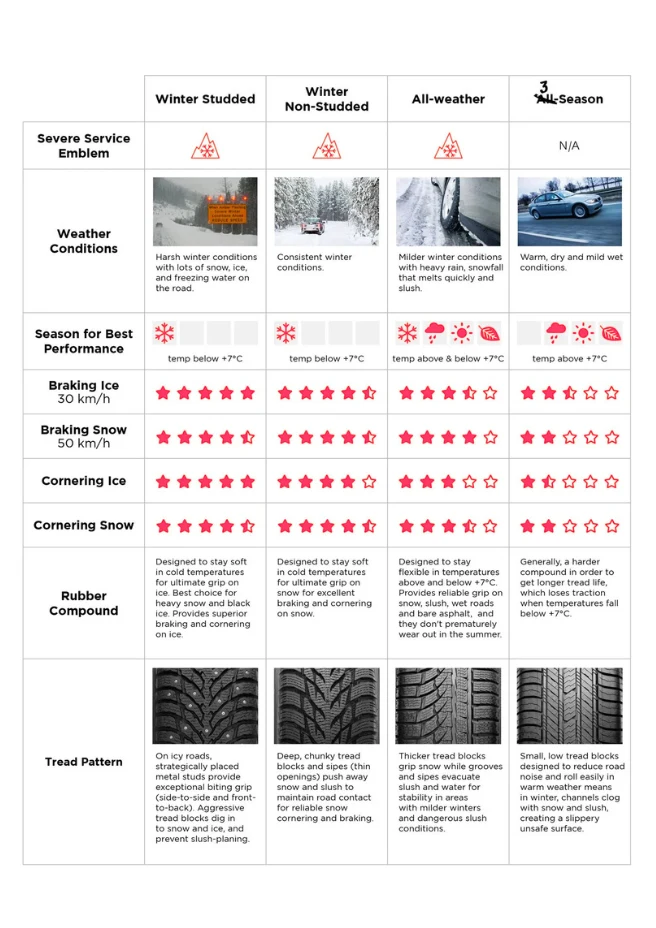
Studded winter tires are another powerful option for drivers facing ice-covered or steep rural roads. These tires deliver maximum traction and shorter stopping distances on slick, frozen surfaces. However, they’re not without drawbacks: studs can be noisy, wear pavement faster and are restricted in certain provinces during specific months.
Before diving into the differences between all seasons, all weather and winter tires, it’s important to understand that each type is engineered for specific driving conditions, temperatures and regional climates. The best tire for you depends on where you live, how you drive and the kind of winter you face. The right choice between all season or winter tires depends on how cold your winters get and how much snow your region receives.
What Are All Season Tires? (A/S)
All season tires, sometimes called 3-season tires, are designed for spring, summer and fall driving in Canada. They perform well on dry and wet roads, offering a quiet ride and long tread life thanks to their harder rubber compound.
However, they lose traction below 7°C and are not recommended for winter use, as the rubber becomes stiff and less grippy on snow or ice. Most all season tires carry the M+S (Mud and Snow) marking, meaning they handle light slush but don’t meet Canada’s winter tire standards.
“Are all season tires good for winter?” → Not really. They’re safe for mild climates but not for harsh Canadian winters.
Pros of All Season Tires
The best all season tires provide long tread life, reliable handling and a smooth, quiet ride in moderate climates.
- Budget-friendly and long-lasting.
- Ideal for spring, summer and fall driving.
- Widely available across Canada, often found in “all season tires on sale” promotions.
If you live in an area with occasional snow, the best all season tires for snow are those rated M+S with deeper tread patterns for added grip.
Cons of All Season Tires
- Not suitable for extreme cold or icy roads.
- Performance decreases below 7°C.
Best for: Drivers in mild Canadian regions or those who avoid winter driving altogether.
What Are All Weather Tires?
All weather tires are a hybrid option that bridges the gap between all season and winter tires offering reliable traction in both warm and cold conditions. They stay flexible above and below 7°C, providing stable grip on rain, slush and light snow without wearing out quickly on dry pavement.
Marked with the Three-Peak Mountain Snowflake (3PMSF) symbol, they’re Transport Canada approved for winter use and can stay on year-round, saving drivers the cost and hassle of seasonal changeovers.
Their only trade-off? A shorter tread life than all seasons, since they’re used through every season. Still, for most Canadians, all weather tires are the best all-in-one choice for safety and convenience.
Pros of All Weather Tires
The best all weather tires combine strong wet-road performance with reliable winter traction, making them perfect for mixed Canadian climates.
- Legal year-round across all provinces, including Quebec and BC.
- Suitable for moderate winter conditions.
- Great choice for urban drivers in regions like Vancouver or Toronto.
Cons of All Weather Tires
- Slightly more expensive than all season tires.
- Shorter lifespan due to softer rubber.
Best for: Drivers who experience mixed weather and want one set of tires for all seasons.
Some drivers choose all season tires with a snowflake symbol, but true winter-rated options are officially marked with the 3PMSF (Three-Peak Mountain Snowflake) certification for guaranteed snow performance. The best all weather tires for snow feature flexible tread compounds and deeper sipes that provide superior grip on slushy and icy Canadian roads.
What Are Winter (Snow) Tires?
Winter tires are also called snow tires. Winter tires are designed specifically for cold, icy and snowy conditions. Made from a soft rubber compound that stays flexible below 7°C, they provide superior grip, braking and cornering on frozen roads.
Their deep tread blocks and tiny sipes clear snow and slush effectively, maintaining strong road contact. Many models can also be studded for extra traction on ice.
Since they wear faster in warm weather, winter tires should be swapped out each spring and stored properly until temperatures drop again. For Canadian drivers facing long or harsh winters, they’re the safest and most reliable choice on the road.
Pros of Winter (Snow) Tires
- Superior traction on snow and ice.
- Shorter stopping distances in cold weather.
- Required by law in some provinces.
Cons of Winter (Snow) Tires
- Wear quickly in warm temperatures.
- Need to be swapped seasonally.
Best for: Drivers in regions with harsh winters, like Quebec, Alberta or Northern Ontario.
All Season vs All Weather vs Winter Tires: Side-by-Side
| Feature | All Season Tires | All Weather Tires | Winter Tires |
|---|---|---|---|
| Temperature sweet spot | > 7°C | Above & below 7°C | < 7°C |
| Symbols | M+S | 3PMSF + often M+S | 3PMSF (some with Ice Grip) |
| Snow/ice performance | Light snow only | Good in snow/slush | Best in snow/ice |
| Changeovers | Not needed | Not needed | Required (spring/fall) |
| Lifespan (typical) | Longest | Moderate | Shorter |
| Convenience | High | Highest (1 set/yr) | Medium (swap + storage) |
How to Identify Tire Symbols?
M+S (Mud & Snow): The all season tire symbol is the M+S marking, meaning “Mud and Snow.” It indicates moderate traction but not true winter certification.
3PMSF (Three-Peak Mountain Snowflake): The all weather tire symbol is the Three-Peak Mountain Snowflake (3PMSF), confirming that it meets winter traction standards recognized by Transport Canada.
Ice Grip: Indicates tires tested for superior braking/handling on ice (seen on some winter models).
How to recognise winter tires: Look for 3PMSF; optionally Ice Grip for icy regions.
How to Choose the Right Tires for Your Canadian Winter
When it comes to tires, most Canadian drivers fall into two categories: those who switch to winter tires every season for maximum grip and those who prefer the convenience of best rated all weather tires they can drive year round. Many Canadians ask whether all season or winter tires make more sense for their area; the answer depends on weather severity and road conditions.
Knowing which type of driver you are can help you make a smarter tire investment, stay safer on the road and get the most value out of your tire budget.
Driver Type #1 – All Weather Tire Drivers
Where you live:
Urban centres and suburban areas
Where you drive:
Mainly city streets and major highways
Typical conditions:
Light snow, slush, wet pavement and mild winters with temperatures that often dip below +7°C
Why all weather tires work for you:
All weather tires are ideal for drivers who want one set of tires year-round without compromising safety. Unlike traditional all season tires, good all weather tires carry the Three-Peak Mountain Snowflake (3PMSF) symbol, meaning they meet Transport Canada’s winter traction standards.
They stay flexible in cold temperatures, grip well in slush and light snow and still perform comfortably on dry roads in summer. If you’d rather avoid seasonal tire changes and storage costs, all weather tires are the most practical and reliable choice for your lifestyle.
Driver Type #2 – Winter Tire Drivers
Where you live:
Cities, suburbs and rural or mountainous regions
Where you drive:
Highways, side roads, unplowed routes and snow-covered terrain
Typical conditions:
Heavy snow, black ice, freezing rain and long, harsh winters with temperatures well below 0°C
Why winter tires work for you:
Winter tires (also called snow tires) are made from a soft rubber compound that stays flexible even at –30°C, giving you maximum traction, braking and cornering control on snow and ice. Their deep tread blocks and zig-zag sipes bite into hard packed snow and channel slush away for a safer, more stable drive.
Driver Type #3 – Studded Winter Tire Drivers
Where you live:
Rural areas, mountain regions or northern communities
Where you drive:
Icy highways, steep hills, unpaved or remote winter roads
Typical conditions:
Persistent ice, hard-packed snow, black ice and frequent freeze thaw cycles
Why studded winter tires work for you:
If you regularly drive on icy or untreated roads, studded winter tires are your best defense against slippery conditions. These tires feature tiny metal studs embedded in the tread that dig into ice, delivering superior traction, stability and shorter braking distances even on glassy surfaces.
They’re especially useful for mountain passes, rural highways and regions with long, freezing winters, where standard winter tires may not provide enough bite.
However, keep in mind that studded tires aren’t legal year-round in all provinces. For example, they’re permitted in most of Canada during the winter months but may have specific start and end dates depending on where you live. Always check local tire laws or ask MMP Auto Repair for advice before installation.
Also Read this: Winter Tire Laws in Canada: Everything Drivers Need to Know
Quick Takeaway
Live in mild or mixed climates? Go with the best all weather tires safe for winter, convenient year-round.
Face heavy snow and extreme cold? Choose winter tires with unmatched grip and safety when temperatures plummet.
Unsure which fits your driving habits? MMP Auto Repair’s experts can help you find the best tire type for your region, vehicle, and budget.
Are Winter Tires Mandatory in Canada?
Regulations vary by province:- Quebec: Winter tires are mandatory from Dec 1 to Mar 15(must have 3PMSF).
- British Columbia: Winter or all weather tires with 3PMSF are required on many highways from Oct 1 to Apr 30.
- Ontario: Not mandatory, but strongly recommended when temps fall below 7°C. Many insurers offer winter tire discounts.
- Alberta & Manitoba: No legal requirement, but highly advisable.
Studdable & Studded Winter Tires
- Why studs? Tiny metal pins bite into ice, boosting acceleration, cornering and braking.
- Best use: Repeated freeze-thaw, black ice, rural/mountain routes.
- Considerations: Road noise, potential pavement wear, provincial restrictions by date/region.
- Ask MMP Auto Repairs: We’ll recommend studded or non-studded based on your route, temperature range and storage.
How Much Do Tires Cost in Canada?
| Tire Type | Typical Cost (each) | Typical Lifespan | Notes |
|---|---|---|---|
| All Season tire cost | $100–$200 | Up to 80,000 km | Long life; not winter-rated |
| All Weather tire cost | $130–$250 | ~60,000 km | One-set convenience; winter-rated |
| Winter tire cost | $120–$300 | ~50,000 km | Best winter safety; seasonal swap |
Total cost of ownership tips
Storage: Keep off-season set in a cool, dry place; consider tire totes.
Changeovers: Book fall/spring early to avoid rush; wheel alignments extend tread life.
Pressure: Check monthly cold snaps, lower PSI and increase stopping distances.
Tire Maintenance Tips for Canadian Drivers
Check tire pressure for winter tires monthly (especially in winter).
Rotate tires every 10,000 km.
Store off-season tires properly in a cool, dry location.
Inspect tread depth replace when below 4 mm.
Are All Season and All Weather Tires the Same?
No, and this is a common misconception. All weather tires are winter rated, while all season tires are not. If you’re driving through Canadian winters, all weather tires will offer far better safety and performance.
When Should You Put On Winter Tires?
Install your winter tires when temperatures consistently drop below 7°C. This ensures the rubber stays soft and maintains traction.
Are All Weather Tires Good for Snow?
Yes, they perform very well in light to moderate snow. They won’t match the grip of dedicated winter tires, but they’re a great compromise for city driving and regions with milder winters. All weather tires in snow perform significantly better than all seasons, maintaining flexibility and grip even in slushy or lightly packed snow.
Also read: Why You Shouldn’t Drive Winter Tires in Summer in Oakville
Why Choose MMP Auto Repairs in Oakville
When it comes to tire safety, quality and expert installation, MMP Auto Repairs in Oakville is your trusted partner on the road. We combine local expertise with access to some of the world’s best tire technology to make sure your vehicle performs safely and efficiently in every season.
Trusted Global Tire Brands
We’re proud to partner with leading global manufacturers, including Michelin, BFGoodrich, Uniroyal, Lassa, Bridgestone, Continental, Dunlop, Firestone, General Tire, Goodyear, Pirelli, Hankook, Toyo Tires, Yokohama, Avon Tyres, Riken and Maxxis. This ensures every set of tires we install meets the highest standards for traction, durability and fuel efficiency perfect for Canadian driving conditions.
Expert Advice Tailored to Canadian Roads
Our technicians understand how drastically the weather changes from province to province. Whether you need all season tires for Vancouver, all weather tires in Toronto, or winter tires for Quebec, we’ll recommend the right fit for your vehicle, climate and driving habits.
Honest Service and Local Care
At MMP Auto Repair, we don’t just sell tires, we build relationships. Our team focuses on safety, transparency and value, helping you make informed decisions that save you money and keep you safe through every season.
One-Stop Shop Convenience
From tire sales and installation to balancing, alignments and seasonal changeovers, we handle it all under one roof saving you time and hassle. We also offer storage solutions for off-season tires, so you never have to worry about space.
Still unsure whether all season or winter tires are best for you? Our experts at MMP Auto Repairs can help you find the perfect fit for your vehicle and region.
Conclusion
Choosing between all seasons, all weather or winter tires comes down to where you live and how you drive. All season tires suit mild climates, all weather tires handle changing Canadian conditions and winter tires give the best grip in snow and ice.
At MMP Auto Repairs, we offer recommended all season tires, best all weather tires and winter tires with rims expertly installed for safety and performance. Stay prepared for every season with tires built for Canadian roads.
FAQs – Tires in Canadian Winters
1. Can I use all season tires in the winter?
You can, but it’s not recommended for Canadian winters. All season tires start to lose grip below 7°C, making them less effective on icy or snowy roads. For better safety and control, switch to all weather or winter tires once temperatures drop.
2. Can I use winter tires in the summer?
Not ideal. Winter tires are made with a softer rubber compound that can wear down quickly in warm weather and reduce fuel efficiency. It’s best to switch back to all season or best all weather tires once spring arrives.
3. Are all season tires good for snow?
They handle light snow reasonably well, but they’re not designed for deep snow or ice. If you live in an area with harsh or unpredictable winters, all weather or winter tires are a much safer option.
4. What does “A/S” mean on tires?
“A/S” stands for All Season. These tires are built for spring, summer and fall driving, offering good all season performance tires in mild conditions but limited traction in winter weather.
5. How can I tell if my tires are all season or winter tires?
Check the sidewall of your tire.
M+S (Mud and Snow) = All season tire.
3PMSF (Three-Peak Mountain Snowflake) = Winter or all weather tire, certified for severe snow performance.
Some winter tires also include an Ice Grip symbol for enhanced traction on ice.
6. Are winter tires mandatory in Ontario?
No, winter tires aren’t legally required in Ontario but they’re strongly recommended for safety. Many insurance companies offer discounts when you install certified winter tires during the cold months.
7. Where can I buy winter tires in Canada?
You can buy quality winter, all weather and good all season tires right here at MMP Auto Repair. We offer winter tires with rims, seasonal tire deals and professional installation from trusted experts.
8. All season vs. all weather tires which is better for Canadian winters?
For most Canadians, all weather tires are the smarter choice. They’re winter rated (3PMSF) and stay flexible in cold temperatures, offering reliable traction without the need for seasonal tire changes.
9. Are all weather tires worth it?
Yes, if you prefer not to switch tires every season and live in an area with mild to moderate winters, all weather tires are a safe, year-round solution. They combine winter performance with summer comfort.
10. Are all season tires safe for winter driving in Canada?
Many drivers wonder whether all season or winter tires are better for safety during the coldest months. While some drivers use all season tires for winter, their traction and braking distance are limited once temperatures drop below 7°C.