

Once the winter season ends in Oakville, a common question comes up: “Can I still drive with winter tires in the summer?” It seems like an easy way to save time and money, but the truth is, using winter tires in summer comes with safety concerns, legal questions and extra costs you might not expect.
At MMP Auto Repair in Oakville, we get this question all the time. Let’s break it down clearly so you know exactly what Ontario law says and whether it’s safe or even smart to keep your snow tires on during summer months.
Driving with a winter tire in summer in Oakville: What does the law say?
Driving winter tires in the summer in Oakville is not recommended because their soft rubber compounds overheat, leading to accelerated wear, reduced grip, and compromised safety. The heat causes the tires to degrade faster, decreasing their lifespan and posing a safety risk, as they are not designed for warm conditions. You should switch to all-season or summer tires when the average temperature consistently rises above 7°C, which typically happens around late March or early April in Oakville.
Can You Drive with Winter Tires in the Summer?
The quick answer: Yes, you can legally drive with winter tires in summer in Ontario.
But here’s the catch: legal doesn’t mean practical. Winter tires are engineered with softer rubber compounds designed for cold weather performance. During the cold season, winter tires (also called thermal tires) stay elastic below 7°C, giving your vehicle better grip on icy and snowy roads.
Once summer arrives and the pavement heats up in June, July or August, that same rubber becomes too soft, overheats and wears down much faster. The result?
Faster disintegration of the tire tread.
Wear markers show up quickly.
Studs or tread blocks soften, reducing stability.
Higher risk of swerving during sudden maneuvers.
In other words, while you won’t get a ticket for it, driving with winter tires in the summer can cost you more money in the long run and compromise your car’s handling and braking on dry or wet roads.
What Happens If You Use Winter Tires in Summer?
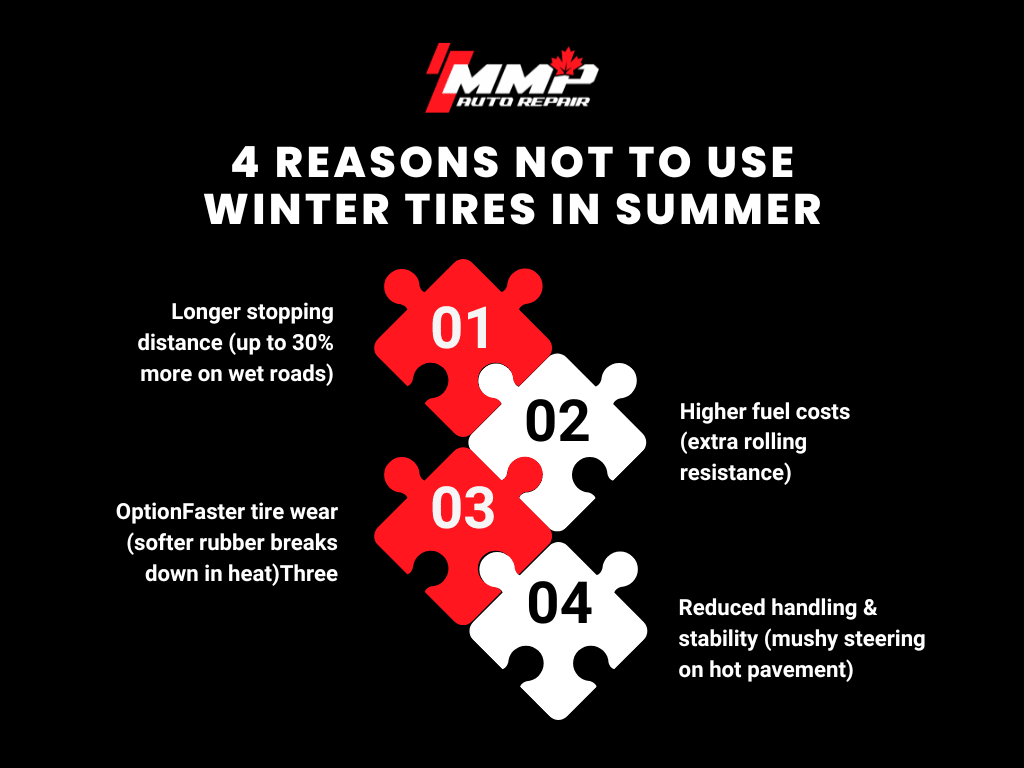
Keeping your winter tires on through Oakville’s summer may seem convenient, but it comes with serious drawbacks:
Longer braking distances – Especially on wet pavement, where tests (CAA-Quebec) show winter tires may need up to 26% more distance to stop compared to all-season tires.
Mushy handling & vague steering – The softer tread blocks designed for cold weather “squirm” on hot asphalt, reducing cornering grip and overall stability.
Accelerated tire wear – Summer heat makes the flexible rubber compound break down quickly, meaning you’ll be shopping for replacements much sooner.
Higher fuel costs – Winter tires have more rolling resistance, which increases gas consumption and makes every trip a little more expensive.
Driving with winter tires in the summer is legal, but it’s harder on your wallet, harder on your tires and harder on your car’s performance.
Is It Bad to Drive Winter Tires in Summer?
Yes. While it’s not illegal to drive with winter tires in the summer, it’s definitely not a smart choice. Winter tires are built for snow and cold weather, not hot pavement. In warm months, they:
Make your car take longer to stop, especially in sudden braking or emergency situations.
Reduce stability during quick turns or lane changes.
Wear out faster, which means you’ll have to replace them sooner.
Tests from CAA-Quebec show that winter tires can need up to 30% more stopping distance on summer roads especially when it’s wet. On Oakville roads like Lakeshore after a rainstorm, that extra distance can be the difference between stopping safely or sliding into trouble.
The Ontario Law on Winter Tires
Are Winter Tires Mandatory in Ontario?
No, Ontario does not require winter tires by law. Unlike Quebec, where snow tires are mandatory from December to March, Ontario leaves it up to drivers. That said, the province and Transport Canada strongly recommend using them in winter for safety. Many insurance companies also offer a 2–5% discount if you install four winter tires during the colder months.
Studded Tires in Ontario: What Oakville Drivers Should Know
Northern Ontario – Studded tires are allowed from October 1 to April 30 and residents registered in the north can legally use them anywhere in Ontario during that time.
Southern Ontario (including Oakville) – Studded tires are not legal for residents. If you use them here, you could face fines of up to $1,000.
Visitors – If you’re from a province where studded tires are legal, you may be allowed to drive in Ontario with them for a limited period, but always confirm the rules before travelling.
When to Change Winter Tires in Ontario
A good rule of thumb is simple: change your winter tires once daytime temperatures stay above 7°C.
In Oakville and the Halton Region, this usually happens between late March and mid-April, depending on the year. Don’t wait until the first heat wave by then, hot pavement will already be wearing down your winter tread much faster than it should.
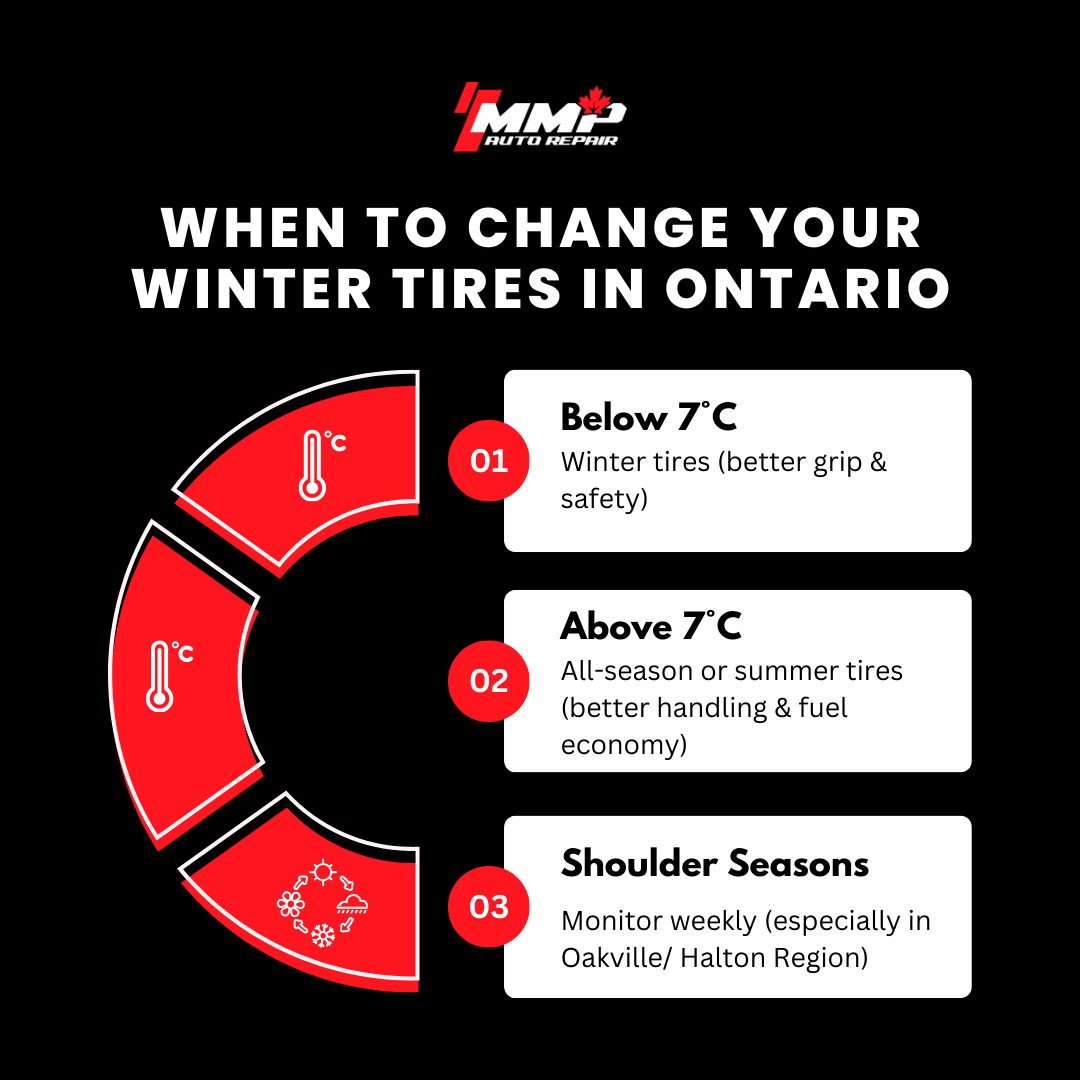
Quick Tire Change Guide for Oakville Drivers
| Condition | Best Tire Choice | Why It Matters |
|---|---|---|
| Below 7°C (late fall–winter) | Winter tires (3PMSF) | Stay flexible in cold, grip icy roads, shorten braking distance. |
| Above 7°C (spring–summer) | All-season or summer tires | Safer braking, better handling, less wear and improved fuel efficiency. |
| Shoulder seasons (early spring/late fall) | Monitor temps weekly | Oakville weather can swing—book early to avoid tire change over rush. |
How to Recognize Snow Tires (3PMSF vs. M+S)
3PMSF (Three-Peak Mountain Snowflake) = true winter tire for severe snow.
M+S (Mud & Snow) = traction pattern only; not a substitute for 3PMSF winter tires.
When Do Winter Tires Come Off?
Aim for mid-April in Oakville, earlier if warm arrives sooner. Delaying costs you tread and fuel. (If a freak cold snap hits, you can reschedule safety first.)
Risks of Driving Winter Tires in Summer
Reduced Braking & Handling
Expect longer stops and less precise steering on the QEW and 403 ramps. Multiple tests show inferior warm-weather braking for winter tires vs. all-season.
Faster Wear & Higher Costs
Soft rubber + hot asphalt = 30–40% faster wear in real-world use (varies by driving). Even conservative estimates show noticeably reduced life if kept on through summer. (Industry and consumer advisories warn against warm-weather use.)
Fuel Economy Penalty
Higher rolling resistance means more fuel. Over a full Oakville summer, that adds up especially with city stop-and-go near Trafalgar and Kerr Street.
Insurance & Liability Considerations in Ontario
Discounts: Many insurers offer ~2–5% off premiums if you install four winter tires during specified months (often Nov–Apr).
Claims: Not having winter tires isn’t illegal, but after a winter crash, insurers or opposing parties may argue negligence if you ran unsuitable or worn tires for the conditions. Keep receipts/photos.
Pros & Cons of Keeping Winter Tires On All Year
| Pros | Cons |
|---|---|
| Avoid seasonal changeover appointment | Longer stopping distances in summer (esp. wet) |
| No storage requirements | Rapid tread wear in heat |
| Always ready for early snowfall | Worse fuel economy |
| Short-term convenience | Higher long-term cost & safety trade-offs |
Expert Recommendations from MMP Auto Repair (Oakville)
Swap by mid-April (or when temperature holds >7°C) to all-season or summer tires.
Rotate & align at each changeover for even wear and straight tracking.
Check tread: Winter tires at ≤5/32″ are poor in slush/snow next season.
No studs in Oakville if you’re a Southern Ontario resident—risk of $1,000 fine.
Book early to beat the spring rush; we’ll inspect brakes/suspension while your wheels are off.
Helpful external resource (official): Ontario’s Winter Driving guidance (safety, tips and tire advice).
Safe & Legal Driving in Oakville
So, can you drive with winter tires in the summer? Yes you can. But between legal considerations, higher costs and safety risks, it’s clear that changing to the right tires at the right time is the smarter move.
If you’re in Oakville and wondering when to change winter tires in Ontario, stop by MMP Auto Repair. Our team will help you switch, balance and align your tires so you can enjoy safe, smooth and fuel-efficient driving this summer.
FAQs: Winter Tire Law in Ontario
1. Can I drive my car with winter tires in the summer?
Yes, you can legally drive with winter tires in the summer in Ontario, including Oakville. But it’s not recommended because they wear down faster, make your car less stable and use more fuel.
2. Is it illegal to have winter tires in summer in Canada?
No, it’s not illegal anywhere in Canada. However, studded tires are restricted in some provinces. In Ontario, studded tires are only allowed in Northern Ontario between October 1 and April 30. In Oakville and Southern Ontario, they’re not legal for residents and could mean fines of up to $1,000.
3. When should I take my winter tires off in Ontario?
You should switch your winter tires to all-season or summer tires once daytime temperatures consistently stay above 7°C. In Oakville, that usually happens in late March to mid-April.
4. What is the policy for winter tires in Canada?
There’s no single Canada-wide policy. Each province sets its own rules:
Quebec: Mandatory Dec 1–Mar 15.
British Columbia & parts of Atlantic Canada: Seasonal requirements on some roads.
Ontario: Not mandatory, but recommended.
5. Can I drive with 3 winter tires and 1 summer tire?
No, that’s unsafe. Mixing different types of tires reduces control, balance and braking. Always use four matching tires all winter, all-season tires or all summer for safe driving.